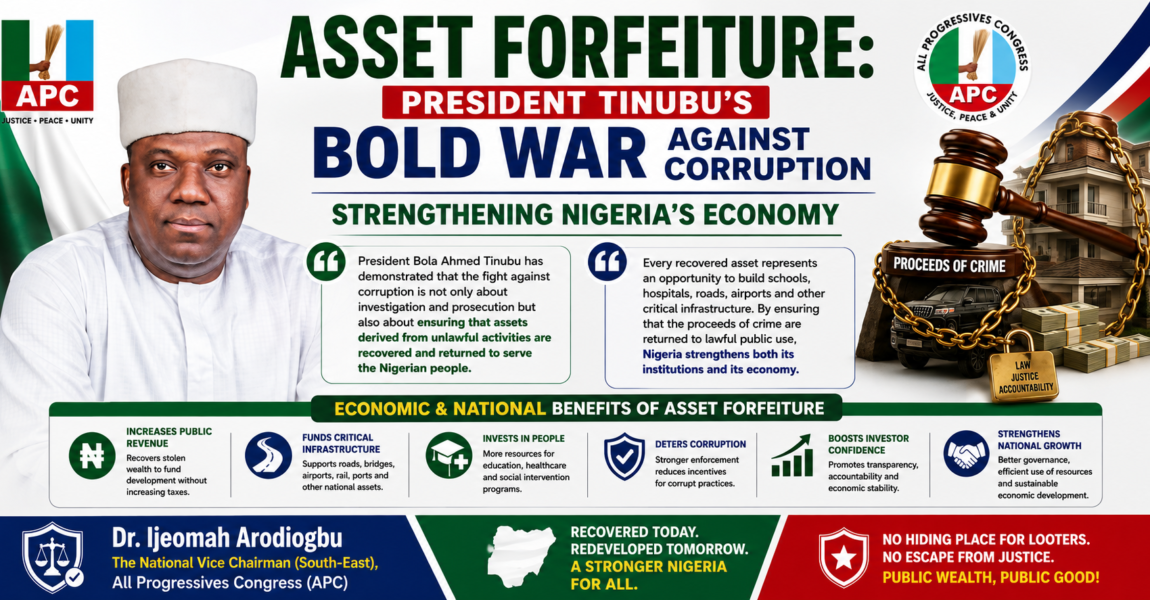
The National Vice Chairman (South-East) of the All Progressives Congress (APC), Dr. Ijeomah Arodiogbu, has described the Federal Government’s intensified asset forfeiture and recovery drive under President Bola Ahmed Tinubu as a major pillar in Nigeria’s anti-corruption strategy, arguing that the policy is helping to safeguard public resources, strengthen accountability and support economic development.
In a statement issued on Tuesday, Dr. Arodiogbu said the Tinubu administration’s emphasis on recovering the proceeds of crime demonstrates a commitment to ensuring that illegally acquired assets are returned to public use rather than remaining in private hands.
According to him, effective asset recovery not only serves as a deterrent to corruption but also creates opportunities for recovered resources to be redirected towards national development priorities.
“President Bola Ahmed Tinubu has demonstrated that the fight against corruption is not only about investigation and prosecution but also about ensuring that assets derived from unlawful activities are recovered and returned to serve the Nigerian people,” he said.
Dr. Arodiogbu noted that Nigeria’s asset recovery framework has been strengthened by the Proceeds of Crime (Management and Forfeiture) Act, 2023, which provides a clearer legal framework for the seizure, management and disposal of assets linked to criminal activities while introducing measures aimed at improving transparency and accountability in asset management.
He further stated that stronger legal and institutional mechanisms are essential to improving investor confidence, promoting transparency in public institutions and protecting public finances.
Dr. Arodiogbu observed that recovered assets have the potential to generate significant economic benefits when properly managed and deployed for public purposes.
According to him, the economic gains include:
- Increased public revenue without imposing additional tax burdens on citizens.
- Funding for critical infrastructure such as roads, bridges, transport systems and public buildings.
- Greater investment in education, healthcare and social intervention programmes.
- Reduced incentives for corruption through stronger enforcement.
- Improved confidence among domestic and foreign investors.
- Better governance and more efficient management of public resources.
- Enhanced fiscal sustainability through the recovery of misappropriated assets.
He added that transparent management of forfeited assets can contribute to sustainable economic growth by ensuring that recovered wealth is reinvested in productive sectors of the economy.
Recent anti-corruption actions have included major court-ordered forfeitures of properties and other assets linked to alleged proceeds of crime. Public reports also indicate that the Economic and Financial Crimes Commission (EFCC) has recorded substantial recoveries in cash and non-cash assets in recent years, supported by the implementation of the Proceeds of Crime Act.
Dr. Arodiogbu noted that, according to official and publicly reported figures, the EFCC has announced recoveries running into hundreds of billions of naira alongside significant recoveries in foreign currencies and non-monetary assets. He said these developments underscore the importance of maintaining strong institutional frameworks for asset recovery and transparent asset management.
He stressed that continued adherence to due process, judicial oversight and transparency remains essential to ensuring public confidence in the asset forfeiture process.
Dr. Arodiogbu urged all anti-corruption agencies, the judiciary and other stakeholders to sustain ongoing reforms aimed at improving transparency, accountability and efficiency in the management of recovered assets.
He also called for greater public awareness of the economic importance of asset recovery, emphasizing that every asset lawfully recovered and returned to government ownership represents resources that can be redirected toward national development.
“Every recovered asset represents an opportunity to build schools, hospitals, roads, airports and other critical infrastructure. By ensuring that the proceeds of crime are returned to lawful public use, Nigeria strengthens both its institutions and its economy,” he said.
He reaffirmed the APC’s support for policies that promote accountability, strengthen public institutions and encourage the prudent management of national resources in pursuit of sustainable economic growth.