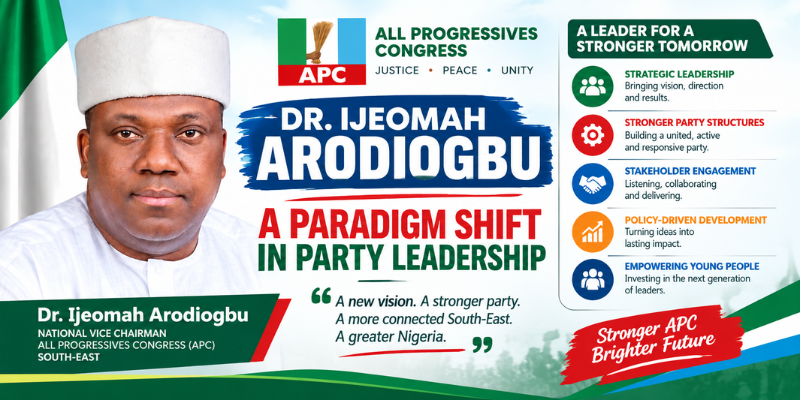
In an era when political leadership is increasingly measured not only by the ability to occupy an office but by the capacity to give direction, build institutions and translate political structures into purposeful action, Dr. Ijeomah Arodiogbu represents an emerging model of party leadership in Nigeria.
As the National Vice Chairman of the All Progressives Congress (APC), South-East, Arodiogbu has increasingly projected a style of leadership centred on organisation, strategic engagement, policy communication, stakeholder coordination and the strengthening of the party’s presence across the region. His re-election to the position in 2026 followed the South-East zonal congress, where delegates adopted a consensus arrangement.
From Political Office to Strategic Leadership
The distinction between holding a political office and providing effective political leadership is significant. A political office provides authority; leadership provides direction.
Arodiogbu’s public engagements broadens the traditional responsibilities associated with zonal party leadership. His activities have extended beyond routine political mobilisation into conversations around economic development, healthcare, education, technology, youth empowerment, international cooperation and the communication of government policies.
In September 2026, for instance, he led an APC South-East engagement with the Embassy of the Czech Republic in Abuja, where discussions covered trade and investment, education, technology, agriculture, healthcare, youth development and cultural exchange.
That approach points to a conception of party leadership in which political structures are expected to connect with the wider development aspirations of the people.
A Leadership Philosophy Built Around Engagement
One notable feature of Arodiogbu’s approach is his emphasis on engagement.
Rather than treating the party structure simply as an electoral machine, his recent public activities have placed considerable attention on communicating government programmes and creating platforms through which political stakeholders can engage with policy issues.
His public interventions have addressed subjects ranging from financial inclusion and economic reforms to primary healthcare, youth skills acquisition, housing and digital-economy regulation.
This reflects a broader understanding of the modern political party: a party must not only seek votes during elections; it must also explain policies, listen to communities, develop leaders and maintain relationships with institutions and citizens between elections.
The Policy Dimension
Arodiogbu’s professional background also shapes the character of his public political engagement. He is a medical doctor, public-health expert and professor of health economics and planning.
That background is visible in his attention to health-sector reforms and public policy.
His interventions on primary healthcare, for example, have focused on functionality, transparency and access, while his comments on economic reforms have frequently attempted to connect national policies with their potential implications for households, businesses and young Nigerians.
The significance of this approach is that it places policy conversation closer to the centre of party communication.
Building a More Connected South-East APC
Another dimension of the emerging leadership model is the effort to strengthen coordination among party stakeholders across the five South-East states.
At the inaugural meeting of the South-East Zonal Executive Committee in April 2026, Arodiogbu chaired deliberations on the state of the party and strategies for strengthening its organisation ahead of the 2027 general elections.
In May, he also spoke on the conduct of National Assembly primaries, highlighting cooperation among stakeholders in the zone.
These activities underscore the importance of internal coordination in a region where political competition, local interests and party structures require continuous engagement.
Leadership Beyond Election Cycles
Perhaps the most important feature of a paradigm shift in party leadership is the movement from election-season politics to continuous political organisation.
A party that wants sustainable relevance must remain active between elections. It must communicate with citizens, engage professional groups, cultivate young people, support policy discussions and maintain relationships with institutions.
Arodiogbu’s recent engagements provide examples of this broader model. His office has participated in conversations involving international diplomacy, economic policy, healthcare, youth development and technology.
This does not eliminate the electoral responsibilities of party leadership; rather, it places electoral mobilisation within a larger framework of organisation and public engagement.
A New Language of Political Communication
Another defining characteristic is communication.
In contemporary politics, policy that is not adequately communicated can easily become disconnected from public understanding. Political leadership therefore increasingly requires the ability to explain complex government initiatives in language that citizens can understand.
Arodiogbu has repeatedly used his public platform to communicate issues ranging from economic reforms to youth opportunities and healthcare interventions. His August 2026 position that the APC’s 2027 campaign should focus on the results of President Tinubu’s policies rather than name-calling illustrates this communication philosophy.
Whether citizens ultimately agree with those policy arguments is a matter for voters and the wider public debate. What is clear is that policy communication has become a central component of his political messaging.
The Challenge of Converting Structure into Results
The real test of any leadership model, however, is implementation. Political structures can produce meetings, statements and campaigns, but sustainable leadership requires measurable organisational outcomes: stronger party institutions, effective grassroots communication, constructive stakeholder relationships, credible internal processes and meaningful participation by young people and professionals.That is where the idea of a paradigm shift becomes consequential.
Arodiogbu’s leadership is increasingly associated with an effort to connect party organisation with policy conversation, political mobilisation with development issues, and regional leadership with wider institutional engagement.
A Leadership Model Still Evolving
It would be premature to describe any contemporary political leadership model as complete. Political organisations are constantly evolving, and the effectiveness of leadership ultimately depends on results that can be assessed over time.
But the trajectory of Dr. Ijeomah Arodiogbu‘s activities in 2026 provides a basis for identifying a distinctive direction: a move towards more strategic, policy-conscious and engagement-driven party leadership in the South-East. His current role places him at an important intersection of party organisation, regional politics and national policy communication.
For now, the emerging picture is that of a party leader seeking to redefine the meaning of the office not simply as a position from which political instructions are issued, but as a platform for coordination, communication, engagement and strategic development.
That, ultimately, is the essence of a paradigm shift: changing the way leadership is understood before changing the structures.