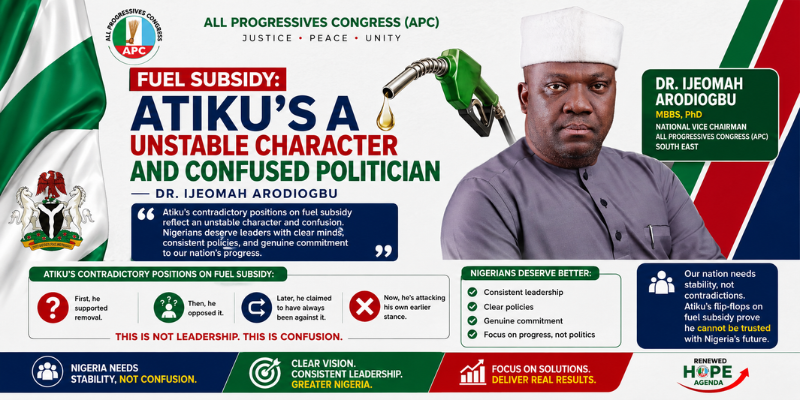
The National Vice Chairman (South-East) of the All Progressives Congress (APC), Dr. Ijeomah Arodiogbu, has described former Vice President Atiku Abubakar’s recent pledge to restore the fuel subsidy if elected in 2027 as evidence of an unstable political character.
Arodiogbu noted that Atiku, while campaigning as the Peoples Democratic Party (PDP) candidate in 2023, had publicly supported and promised to remove the fuel subsidy within his first 100 days in office. President Bola Tinubu announced the end of the subsidy on May 29, 2023, during his inauguration, a step aligned with the Petroleum Industry Act and long advocated by major candidates, including Atiku.
“Having supported the removal in 2023, only to now vow to bring it back because of political convenience shows inconsistency and a lack of firm principles,” Arodiogbu said.
“During the 2023 elections, Atiku Abubakar told Nigerians that he was going to remove the fuel subsidy. Today, because he is looking for votes, he is vowing to return it. This flip-flop clearly shows an unstable character and a lack of consistent ideology, He stated that Atiku’s volte-face prioritises electoral appeal over Nigeria’s long-term economic stability.” Arodiogbu stated.
“Any promise to return to the old subsidy regime is a promise to return Nigeria to the era of unmitigated corruption, where a few cabals pocketed trillions of naira at the expense of the masses,” he said.
“We are already seeing the dividends of this bold decision through infrastructure development and enhanced financial autonomy for the States and Local Government. We cannot afford to reverse this progress simply for political expediency.”
Arodiogbu listed substantial benefits already accruing from the removal of the petrol subsidy and liberalisation of the naira which generated ₦15.8 trillion in resources for the Federation between June 2023 and December 2025. Of this, approximately ₦5.4 trillion went to the Federal Government while ₦10.4 trillion was shared by states and local governments through the Federation Account Allocation Committee (FAAC).
He argued that the removal, despite its initial economic hardships, has untangled the nation’s fiscal constraints and freed up crucial resources for national development. Listing the specific gains, Arodiogbu pointed to the significant increase in monthly financial allocations to state and local governments, which he noted is now being deployed for grassroots infrastructure, healthcare, and education.
Arodiogbu stressed that continuous funding of the old subsidy regime was unsustainable and would have further strained public finances. He maintained that while the policy has imposed short-term hardships, the structural gains, higher subnational revenues, reduced fiscal leakage, and a more market-oriented downstream petroleum sector position Nigeria for longer-term recovery and growth.
Furthermore, Arodiogbu highlighted that the policy shift has effectively dismantled the massive corruption and smuggling syndicates that historically drained the country’s resources under the guise of fuel import
He urged voters to make the 2027 election a contest of ideas, policies, records and credible solutions to Nigeria’s economic challenges.
“Politics must not be about saying whatever is convenient at a particular moment. Nigerians deserve consistency, honesty and responsible leadership. We should debate the results of reforms and how to improve them, not simply promise a return to policies that have already demonstrated their limitations,” Arodiogbu said