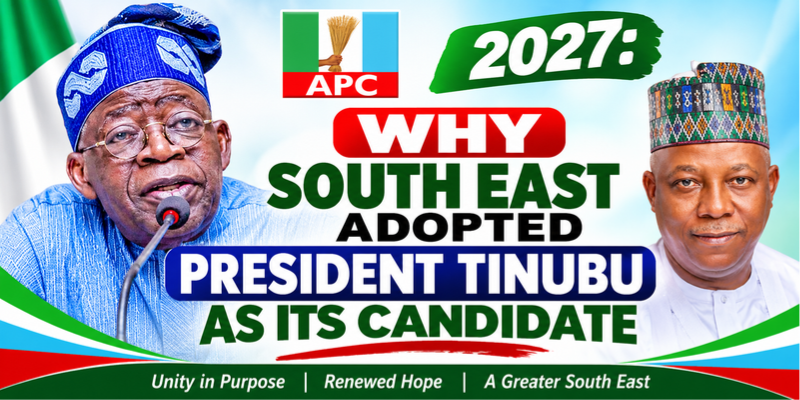
The South-East has spoken with clarity and resolve. After careful assessment of performance, infrastructure delivery, appointments, economic interventions, and the practical realities of national politics, the zone adopted President Bola Ahmed Tinubu as its sole and undisputed presidential candidate for the 2027 general elections. This is not sentiment. It is reciprocal politics rooted in measurable results and strategic foresight.
For decades the South-East laboured under a sense of marginalisation. Critical roads remained death traps. Federal presence was thin. Appointments into key national positions were scarce relative to the zone’s population, economic contribution and human capital. In 2023 many of our people expressed legitimate fears about the Muslim-Muslim ticket and withheld significant support. The APC scored a mere fraction of the votes it needed in the region. That chapter is closed. Three years of governance under President Tinubu have rewritten the narrative.
The most visible evidence of the administration’s commitment is the aggressive bridging of long-standing infrastructural gaps. Dualisation of the Enugu-Abakaliki Road, progress on the Enugu-Onitsha Expressway, work on the Calabar-Ebonyi-Benue Trans-Saharan Superhighway and other major corridors are not abstract promises. They are concrete projects that ease movement of goods, reduce travel time, lower costs for traders and farmers, and open the region to greater economic activity. These interventions represent a clear break from the pattern of neglect that characterised previous years. When a government invests heavily in the physical arteries of a region, the people notice. Reciprocity becomes logical.
South-East APC governors and leaders —Imo’s Hope Uzodimma, Enugu’s Peter Mbah and Ebonyi’s Francis Nwifuru have repeatedly affirmed that these projects form a strong foundation for political alignment with the centre. The zone is no longer content to remain on the periphery. It is positioning itself as a strategic partner in the Renewed Hope Agenda.
Beyond roads, the elevation of sons and daughters of the South-East to key national positions has reinforced the sense of belonging. Inclusive governance is not a slogan when it is reflected in the composition of the federal executive, agencies, boards and commissions. President Tinubu has demonstrated a willingness to appoint capable South-Easterners.
The logic is straightforward: if the region delivers a more substantial bloc of votes in 2027, moving from the meagre percentages of 2023 toward 30 or 40 per cent, its bargaining power for further appointments, ministerial slots, agency heads, military and paramilitary positions, and federal boards will increase correspondingly. Politics is about numbers and rewards. The South-East understands this arithmetic.
The administration’s broader economic programmes have also touched ordinary lives. Housing reforms through the MOFI Real Estate Investment Fund have enabled thousands of Nigerians, including families in the South-East, to access long-term mortgages at single-digit interest rates with modest equity contributions. The shift from perpetual tenancy to home ownership is tangible. The expanded NG-CARES programme has channelled livelihood support, agricultural inputs, cash transfers and enterprise grants to petty traders, artisans, smallholder farmers and vulnerable households. In a region whose economy rests heavily on commerce, manufacturing and entrepreneurship, these interventions matter. They demonstrate that the Renewed Hope Agenda is not confined to Abuja or the South-West.
President Tinubu’s recent engagement with Igbo traders and business leaders in Lagos further underscored mutual respect. Ndigbo in Lagos and across the country are pragmatic. They recognise where their economic interests are protected. After three years of governance, the earlier fears surrounding the religious composition of the ticket have largely dissipated. Competence, capacity and performance have taken precedence. The Igbo nation has not been short-changed.
There is also a longer-term calculation. Tinubu’s second term, if secured, runs to 2031. That creates a natural window for negotiating the South-East’s place in the national power rotation thereafter. Supporting a performing president who has already shown openness to the zone strengthens the region’s moral and political claim when the next zoning conversation intensifies. Narrow personal ambitions or the politics of permanent opposition have not delivered the infrastructure, capital or federal inclusion the South-East needs. Strategic partnership with the centre offers a clearer path.
Stakeholders’ meetings of South-East APC leaders have therefore issued unambiguous communiqués. The zone declares its unalloyed, total and unwavering support for President Bola Ahmed Tinubu as its sole presidential candidate. Governors, party structures, traditional institutions and progressive forces across Abia, Anambra, Ebonyi, Enugu and Imo are aligning. The message is consistent: the South-East will mobilise and deliver bloc votes in 2027.
The contrast between 2023 with 2027 is stark. Then, hesitation and fear shaped voting patterns. Today, results on the ground, roads under construction, appointments made, economic programmes reaching households, and open engagement with the business community have shifted the conversation. Unity within the APC in the South-East, reconciliation of internal differences, and focused mobilisation are the tasks ahead. The region is ready to host the President and the Vice President for campaign engagements. It is ready to demonstrate that progressive politics and meaningful national partnership are possible.
This is not blind loyalty. It is calculated reciprocity. The South-East has received substantial federal attention in infrastructure and inclusion. It is prepared to respond with electoral support that reflects that investment. In doing so, it strengthens its own hand for the future while contributing to national stability and development.
President Tinubu has shown that competence and fairness can overcome earlier suspicions. The South-East has responded by adopting him as its candidate for 2027. The work of mobilisation continues. The logic is clear. The decision is firm.
Dr. Ijeomah Arodiogbu
National Vice Chairman (South-East), All Progressives Congress
Co-Zonal Coordinator, APC Presidential Campaign Council (South-East)