The Coalition of Lawyers for Justice and Equity has strongly condemned the judgment of the Federal High Court, Abuja, delivered on 29 October 2026 by Justice Obiora Egwuatu in Suit No. FHC/ABJ/CS/1854/2026, which nullified the nomination of Imo State Governor Hope Uzodinma as the All Progressives Congress (APC) candidate for Imo West Senatorial District and directed the Independent National Electoral Commission (INEC) to recognise former Governor Rochas Okorocha instead.
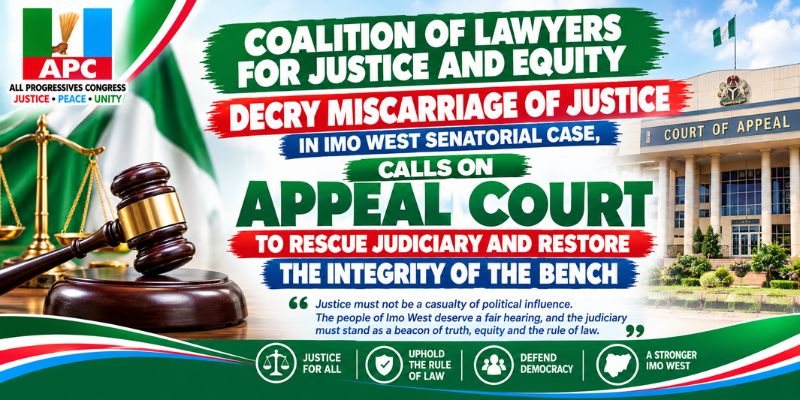
In a detailed statement issued in Abuja, the Coalition described the decision as a “complete travesty of justice,” a frontal assault on settled constitutional principles, and a dangerous precedent that undermines the integrity of the judiciary. The group has called on the Court of Appeal to urgently intervene, reverse the judgment, and restore public confidence in the Bench.
The APC primary for Imo West Senatorial District was held on 18 May 2026 and monitored by INEC. The party declared Governor Uzodinma the winner. Okorocha, who contested the primary, approached the Federal High Court by Originating Summons filed on 13 August 2026 a full 87 days after the primary seeking to be declared the winner and to have Uzodinma’s name removed from INEC’s list of candidates.
Justice Egwuatu held that Okorocha had secured the majority of votes, ordered the APC to forward his name to INEC, directed INEC to publish Okorocha as the candidate for the January 2027 election, and restrained Uzodinma from parading himself as the party’s nominee.
The Imo State Government, through Commissioner for Information Declan Emelumba, immediately rejected the ruling as a travesty of justice and announced that an appeal would be filed. The APC Imo State chapter similarly insisted that Uzodinma remains its authentic candidate.
The Coalition’s primary objection is that the suit was hopelessly statute-barred. Section 285(9) of the Constitution of the Federal Republic of Nigeria, 1999 (as amended by the Fourth Alteration) provides in mandatory terms:
“Notwithstanding anything to the contrary in this Constitution, every pre-election matter shall be filed not later than 14 days from the date of the occurrence of the event, decision or action complained of in the suit.”
This provision, introduced to curb the previous culture of endless pre-election litigation that destabilised governance, has been given strict interpretation by the Supreme Court in a long line of authorities spanning more than two decades.
In Garba v. APC (2020) 2 NWLR (Pt. 1708) 345 and Zailani v. Gumau (2019), the Supreme Court held that suits filed outside the 14-day window are statute-barred and that the court is robbed of jurisdiction.
The period begins to run from the date of the event complained of (here, the primary of 18 May 2026), not from the date the complainant claims to have become aware of any alleged wrong. Subsequent decisions, including Karshi v. Gwagwa (2022) LPELR-57544(SC) and later authorities up to 2025–2026, have consistently reaffirmed that the 14-day limitation is jurisdictional and non-extendable by the court.
By filing on 13 August 2026 87 days after the primary Okorocha’s suit was filed more than six times outside the constitutional window. The trial court was under a duty to decline jurisdiction. Its failure to do so, the Coalition submits, constitutes a fundamental miscarriage of justice.
The second major flaw identified by the Coalition is the mode of commencement. The suit was brought by Originating Summons. Nigerian jurisprudence has long established that Originating Summons is unsuitable where the facts are highly contentious or where allegations of fraud, forgery or perjury are raised.
In APC v. Bashir Sheriff (2023) SC/CV/1689/2022, the Supreme Court (per Nweze, JSC) held that where a plaintiff alleges fraudulent substitution or relies on documents tainted by allegations of forgery, the proper procedure is by Writ of Summons so that pleadings, oral evidence and cross-examination can test the claims.
Earlier authorities, including Inakoju v. Adeleke and decisions applying Order 3 Rule 2(b) of the Federal High Court (Civil Procedure) Rules, 2019, reinforce that suits founded on fraud cannot properly be determined on affidavit evidence alone.
The Coalition notes that the case before Justice Egwuatu involved competing result sheets, allegations of forged primary reports, and claims of perjury. INEC itself had earlier written to security agencies describing one circulating document as “fraudulent and fictitious.”
A Magistrate’s Court in Abuja had even issued bench warrants against Okorocha and others over related allegations of conspiracy, forgery and uttering of false documents. In such circumstances, determining the dispute solely on affidavit evidence, the Coalition argues, was a clear departure from binding Supreme Court authority.
The Coalition observes that the judgment risks eroding the carefully constructed constitutional architecture for pre-election disputes put in place by the Fourth Alteration. From the early 2000s through the post-2018 regime, the courts have repeatedly emphasised that time is of the essence in electoral matters and that jurisdiction cannot be conferred by consent or waived by the parties.
Decisions such as ANPP v. Goni, Bello v. Yusuf, and more recent authorities up to 2026 have consistently held that once the statutory period expires, the right of action is extinguished. To ignore this clear constitutional command, the Coalition contends, is to invite chaos and to undermine the predictability that the law is meant to provide.
Furthermore, the Coalition stresses that the integrity of the Bench depends on strict fidelity to established precedent. When a trial court appears to disregard both the plain words of Section 285(9) and a consistent body of Supreme Court decisions on the proper procedure for fraud-related claims, public confidence in the judiciary is inevitably damaged.
The Coalition of Lawyers for Justice and Equity therefore urgently calls on the Court of Appeal to:
- Assume jurisdiction over the impending appeal with the expedition demanded by Section 285(11) and (12) of the Constitution (appeal within 14 days; disposal within 60 days);
- Reaffirm the jurisdictional force of the 14-day limitation under Section 285(9);
- Hold that a suit founded on allegations of forgery and highly disputed facts cannot properly be determined by Originating Summons on affidavit evidence alone; and
- Set aside the judgment of the Federal High Court in its entirety and restore the status quo ante.
- The Coalition emphasises that this is not a partisan intervention. It is a professional duty owed to the Nigerian legal system and to the Nigerian people. The judiciary remains the last hope of the common man only for as long as it remains faithful to the Constitution and to its own precedents.
“We call on the Court of Appeal to rescue the judiciary from this clear miscarriage of justice and to restore the integrity of the Bench,” the Coalition stated. “Anything less would be a disservice to the rule of law and to the democratic process.”
The statement was signed by Barrister Chukwuma Okorie, Convener of the Coalition of Lawyers for Justice and Equity, and circulated to the media, the National Judicial Council, and relevant stakeholders.