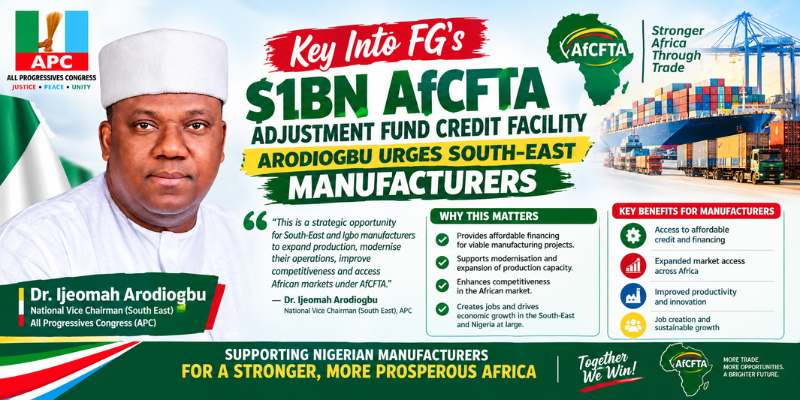
The National Vice Chairman, South-East of the All Progressives Congress (APC), Dr. Ijeomah Arodiogbu MBBS, Phd, has urged manufacturers, industrialists and exporters in the South-East, as well as Igbo entrepreneurs operating across Nigeria, to take advantage of the Federal Government’s $1 billion AfCFTA Adjustment Fund Credit Facility.
Arodiogbu said the facility presents an opportunity for Nigerian businesses to strengthen production capacity, modernise their operations, improve competitiveness and expand their presence in markets across Africa under the African Continental Free Trade Area (AfCFTA).
The APC South-East leader made the call following the Federal Government’s unveiling of the financing initiative as part of efforts to deepen Nigeria’s participation in continental trade and strengthen domestic production.
He described the facility as particularly relevant to the South-East because of the region’s established industrial and commercial centres, including Onitsha, Nnewi, Aba and Enugu, where thousands of businesses operate across manufacturing, trading, pharmaceuticals, plastics, automotive components, textiles, agro-processing and other sectors.
“Our people are hard-working, innovative and business-oriented. This administration under President Bola Ahmed Tinubu has created an enabling environment for commerce, investment and manufacturing. The AfCFTA Adjustment Fund Credit Facility provides an opportunity for serious businesses to expand production, modernise their plants and compete more effectively in the African market,” Arodiogbu said.
According to the facility framework outlined by the Federal Government, eligible large African businesses can access financing for areas including term loans, working capital, trade finance and project finance, with the facility intended to support business expansion, industrial development and regional value-chain integration.
Arodiogbu urged eligible companies to begin preparations early rather than wait until financing windows become highly competitive.
He said manufacturers seeking to benefit should ensure that their corporate governance, financial records, business plans, production capacity and proposed projects are properly documented.
“This is not simply about accessing capital. It is about building productive capacity and positioning Nigerian businesses for the African single market. Companies that invest in technology, standards, quality control, production efficiency and market expansion will be better positioned to take advantage of continental trade,” he stated.
Arodiogbu said the South-East has several existing industrial clusters that could benefit from increased access to finance and continental markets. He cited the entrepreneurial ecosystem around Nnewi, Onitsha, Aba and other manufacturing centres as evidence of the region’s capacity to produce goods for both domestic and international markets.
He encouraged manufacturers to use the AfCFTA framework to move from predominantly domestic distribution to structured export operations targeting African markets.
According to him, businesses should pay particular attention to product quality, standards compliance, packaging, certification, rules of origin and reliable supply capacity, which are important to competing effectively in regional markets.
The APC South-East leader also advised businesses intending to export to regularise their operations with the Nigerian Export Promotion Council (NEPC).
NEPC states that businesses seeking to export from Nigeria are required to register through its electronic registration platform. The council’s exporter certificates are initially valid for two years, after which they are renewable annually.
The council also administers the Export Development Fund (EDF) and Export Expansion Grant (EEG) as export-support mechanisms. The EDF provides assistance for activities including export promotion, conformity assessment, market research, trade fairs and development of export-oriented industries, subject to its eligibility requirements.
Arodiogbu advised interested businesses to:
Establish their eligibility and obtain accurate guidance from the relevant AfCFTA and government institutions before applying.
Prepare audited financial statements, business plans, project proposals and corporate documentation required by financing institutions.
Obtain and maintain NEPC exporter registration where applicable.
Upgrade production facilities and quality-control systems to meet relevant African and international standards.
Work with chambers of commerce and recognised manufacturers’ associations to improve access to information, market linkages and technical support.
Develop export strategies targeting specific African markets, rather than relying solely on domestic demand.
“The message to our manufacturers is simple: prepare, formalise, modernise and expand. The African market is becoming increasingly integrated, and Nigerian businesses must position themselves to supply that market competitively,” he said.
He expressed the view that stronger access to industrial finance, combined with improved infrastructure, standards compliance, export support and market access, could help deepen manufacturing and export activity in the South-East and contribute to Nigeria’s broader economic diversification objectives.