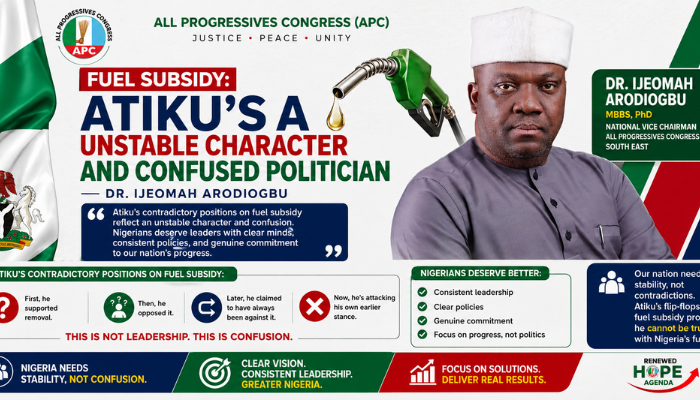
By Dr. Ijeomah Arodiogbu
The recent gathering of Nigerian opposition figures in Ibadan, where participants announced an agreement to field only one candidate for the 2027 presidential election, represents an exercise of limited practical significance within the evolving terrain of the country’s multiparty democracy. This conclusion arises directly from the composition of the assembly itself, which consisted of individuals drawn from a specific faction within the African Democratic Congress that holds no official standing before the Independent National Electoral Commission because of enforceable court rulings that have placed the group’s status in abeyance. When a political initiative originates from such an uncertain foundation, it inherently lacks the institutional weight necessary to influence national electoral outcomes or to reshape the competitive dynamics ahead of any major poll. The factional nature of the participants means that their deliberations carry no binding authority over the wider political ecosystem, and any pronouncements issued from the venue amount to little more than expressions of individual sentiment rather than coordinated party strategy.
In any functional democratic system, the recognition of political parties by the electoral umpire serves as the bedrock of legitimacy, allowing formations to nominate candidates, register voters, and engage in lawful campaign activities without fear of disqualification or legal challenge. Here, the absence of such recognition for the African Democratic Congress faction involved in the Ibadan meeting creates an immediate barrier to credibility. Court orders have explicitly curtailed the ability of this group to act on behalf of the party, preventing it from conducting official business or claiming to speak for a registered entity. This situation highlights a deeper structural weakness, because political parties must operate within clearly defined legal parameters if they are to command respect from the electorate and from state institutions. Without that compliance, the gathering could not translate its resolutions into actionable steps such as candidate selection or alliance formation that would withstand scrutiny during the nomination processes or at the polls. Instead, the event risked reinforcing perceptions of disarray among opposition elements at a time when voters increasingly demand coherence and seriousness from those seeking to offer alternatives to the ruling dispensation.
Compounding this issue is the evident inability of the participants to organize themselves effectively or to establish a legitimate leadership framework capable of sustaining momentum beyond a single meeting. Internal divisions have long plagued the African Democratic Congress, with competing claims to authority that have resulted in parallel structures and unresolved disputes over who truly controls the party’s apparatus. Such fragmentation prevents the emergence of a unified command that could mobilize resources, develop policy platforms, or build grassroots networks essential for any presidential bid. When leaders cannot even resolve their own succession or decision making protocols, it becomes difficult to project an image of readiness to govern a complex federation like Nigeria. The Ibadan assembly therefore appears more as a momentary convergence of personal ambitions than as a deliberate step toward building enduring institutional capacity. This lack of organization erodes public confidence, because citizens have witnessed too many instances where opposition efforts collapse under the weight of ego clashes or procedural irregularities, leaving the field open for the incumbent power to consolidate without meaningful contest. Effective opposition requires not just rhetoric about unity but the prior establishment of accountable hierarchies that can endure legal and logistical pressures over the long campaign cycle leading to 2027.
It would be misleading to draw parallels between this Ibadan gathering and the successful merger of opposition parties in 2015 that ultimately produced the late President Muhammadu Buhari as a sole presidential candidate under the All Progressives Congress banner. The 2015 process involved fully recognized political entities that voluntarily dissolved their separate identities through formal negotiations and legal registration procedures to create a new party with clear leadership and operational guidelines. Those parties entered the merger with established structures intact, allowing them to pool resources, delegate responsibilities, and present a cohesive front that resonated with voters disillusioned by the status quo. In contrast, the African Democratic Congress today possesses no such legitimate leadership core, because ongoing court interventions have frozen its internal governance, leaving the faction at the Ibadan meeting without the authority to bind the party or its potential allies in any enforceable manner. The fundamental difference lies in the presence of institutional integrity in one case and its absence in the other, rendering any comparison superficial and unhelpful for understanding the requirements of credible coalition building. The 2015 merger succeeded because it rested on mutual consent among equals operating within the law, whereas the current effort begins from a position of contested legitimacy that invites immediate legal and political rebuttals.
Furthermore, it remains improper for those associated with the African Democratic Congress factional gathering to assert that all opposition parties endorsed their announced decision on a single presidential candidate. Such a claim overreaches the actual participation at the event, particularly since major opposition platforms including the All Progressives Grand Alliance and the Labour Party, both of which control sitting governorships in key states, chose not to attend or associate themselves with the proceedings. The absence of these parties, with their established track records of electoral success at the subnational level and their independent organizational strengths, underscores the selective nature of the Ibadan consensus. It cannot be presented as a comprehensive opposition accord when influential actors with proven administrative experience and regional influence remain outside the fold. This selective framing risks alienating potential supporters who view the declaration as an exclusionary manoeuvre rather than an inclusive effort to forge a broad based alternative. In Nigerian politics, where regional sentiments and gubernatorial influence often determine national viability, the exclusion of voices from parties holding executive power in states signals a gap that undermines the narrative of unified resolve. Claiming universal agreement in their absence distorts the reality of fragmented opposition efforts and could foster mistrust among observers who expect transparency in coalition talks.
The broader implications of this irrelevance extend to the health of Nigeria’s democratic institutions, where premature declarations of unity without foundational legitimacy can distract from the genuine work required to mount competitive challenges. Voters deserve opposition formations that demonstrate readiness through disciplined internal processes rather than headline grabbing summits that evaporate upon contact with legal or logistical realities. The Independent National Electoral Commission’s role in enforcing court orders serves as a safeguard against anarchy in party politics, ensuring that only compliant entities participate fully in the electoral process. When factions bypass these safeguards, they inadvertently weaken the very system they seek to influence and diminish their own prospects for success. This dynamic has played out repeatedly in past cycles, where poorly coordinated opposition initiatives fragmented the anti incumbent vote, allowing the ruling party to secure victories. The Ibadan meeting fits this pattern by prioritizing a symbolic gesture over the painstaking task of resolving leadership vacuums and securing institutional support.
Beyond the immediate legal and organizational shortcomings, the gathering also reveals a strategic miscalculation in timing and sequencing. Opposition politics in a presidential system demands long term planning that begins with strengthening party apparatuses at ward and local government levels before contemplating national tickets. Attempting to impose a single candidate framework on entities still grappling with basic recognition issues skips critical stages of development and exposes the participants to accusations of desperation. Nigerian voters have grown more sophisticated in evaluating political offers and they tend to reward formations that exhibit stability and foresight rather than those that announce grand plans while struggling with elementary compliance. The inability to produce a legitimate leadership within the African Democratic Congress faction therefore dooms the initiative to marginal impact, because it cannot deliver on the logistics of candidate vetting, alliance management, or campaign coordination that a credible 2027 effort would require.
Moreover, the political environment in Nigeria today features an electorate increasingly attuned to issues of governance delivery and institutional integrity, making it essential for opposition groups to project competence from the outset. A gathering marred by derecognition concerns fails this test and instead highlights the persistent challenge of factionalism that has historically hampered efforts to build viable alternatives. To overcome this, the opposition must prioritize the consolidation of their internal structures, ensuring that leadership contests are resolved through transparent mechanisms and that party organs operate with full legal backing. Only then can discussions about candidate unification carry substantive weight and attract the cross regional support needed to contest effectively at the presidential level.
In light of these realities, the opposition would do well to focus first on organizing themselves properly if they harbour any serious intention of participating meaningfully in future presidential elections. This entails resolving all pending leadership disputes through judicial or internal democratic channels, securing unequivocal recognition from the electoral commission, and forging alliances based on shared programmatic visions rather than ad hoc pronouncements. Such foundational work, though time consuming, offers the only pathway to building the trust and infrastructure necessary for mounting a credible presidential challenge. Without it, any talk of single candidacies or grand coalitions remains aspirational at best and counterproductive at worst by fostering illusions that ultimately disillusion the public. Nigerian democracy benefits from robust opposition, but that robustness must be earned through disciplined self examination and adherence to legal norms, not assumed through gatherings that sidestep those very requirements. The Ibadan event, while perhaps well intentioned in its stated goals, ultimately serves as a reminder that form without substance yields little in the complex arena of national politics.
Expanding on this point, the path to effective opposition unity requires deliberate investment in capacity building that encompasses financial transparency, membership mobilization, and policy articulation across diverse ideological spectrums. Parties must cultivate leaders who command respect not merely through rhetoric but through demonstrated ability to manage complex organizations under pressure. The African Democratic Congress faction’s ongoing struggles illustrate how neglect of these elements can render platforms ineffective, leaving them vulnerable to internal collapse. By contrast, successful historical examples in Nigerian politics underscore the value of methodical preparation, where mergers or coalitions emerge only after each component has stabilized its own house.
Ultimately, the irrelevance of the Ibadan gathering lies in the mismatch between ambition and readiness. Nigerian politics has seen enough instances of opposition missteps to recognize that sustainable change demands more than declarations. The events in Ibadan, while generating temporary headlines, have done little to alter the fundamental equation that legitimacy, organizational coherence, and inclusive participation remain indispensable for any meaningful challenge in 2027.
Dr. Ijeomah Arodiogbu is the National Vice-Chairman (South-East) of the All Progressives Congress.